Register
to get articles and more to your inbox
News & insights
Archive
Directory
King Power Gives Back To Thai Football With Latest Infrastructure Deal
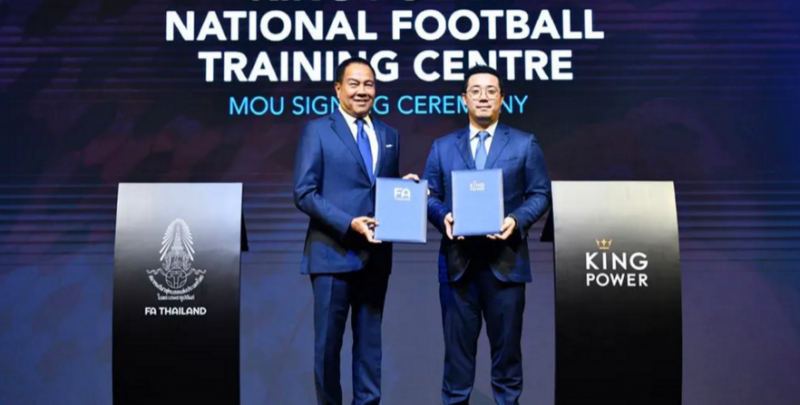
The Football Association of Thailand (FAT) and Thai travel retailer King Power, owner of Leicester City, have signed a memorandum of understanding (MoU) for the construction of a new national football training centre.
King Power will back the construction of the centre to a tune of US$16.5m and will also be granted naming rights to the venue. The King Power National Football Training Centre will be in Muak Lek, Saraburi, on 240,000 square metres of land allocated by the Sports Authority of Thailand.
The MoU was signed by FAT President Ret. Pol. Gen. Somyot Poompunmuang and King Power’s chief executive Aiyawatt Srivaddhanaprabha, who is also the Leicester City’s chairman. Following the deal, Somyot added, “King Power has the experience and know-how of the English model from managing Leicester City which can help us lay a good foundation for developing Thai football through this training centre.”
“It is important to have a master plan, but it is equally important to have a centre to put that plan into action. I have always insisted on having short- and long-term plans to ensure sustainable development.”
The collaboration under the MoU will include the FAT tapping Leicester City’s expertise on football related-science, such as the latest developments in sports and nutritional sciences.
The training centre is one of the major projects under a long-term national football development plan initiated by Somyot. The centre will have different types of football facilities including futsal and beach football, and also host national youth football championships. It will house a museum of Thailand’s football history and be a venue for the FAT seminars and events. The FAT is presently selling the domestic and international media rights for the Thai national team and club football for 2021 to 2028.
According to ASN data, King Power has invested almost US$9.4m across the Asian sponsorship landscape since Q117, with all its spend funnelling into its domestic market. The bulk of this spend (~73.4%) has been skewed towards football with this latest deal continuing the pattern.